Rainmaking
The Glass Bead GameRainmaking is the inherited art through which a village Rainmaker interprets the moon and weather, determines the timing of sowing, and acts on behalf of the community when crops are endangered. In Joseph Knecht’s life as a Rainmaker, the practice joins close observation of nature to ritual obligation and a sense that human beings belong within forces they cannot master. Its most consequential test comes in a season of crop failure and drought, when the community’s rites bring no relief and Knecht offers his own life while securing the succession of his son, Turu.
Office and Community
The Rainmaker’s work is not simply a private craft or a permanent claim to authority. In ordinary times, Turu lives much as other members of the village do: he helps cultivate common land, tends a small garden, and gathers, hunts, and fishes. His standing rises when the community needs his special knowledge. He receives payment for services on particular occasions, but his central public responsibility is to determine, in spring, the proper day for sowing different fruits and plants.
That judgment depends partly on inherited rules and partly on the Rainmaker’s own experience of the moon. Yet the authority to make the first sowing belongs elsewhere. The opening act of scattering the first grain and seeds on community land is considered too sacred for a man to perform; the tribal mother, or her oldest female relative, conducts it. The arrangement distinguishes the Rainmaker’s expertise from the community’s highest ritual authority: he identifies the time, while the tribal mother inaugurates the season.
Rainmaking also has a crisis function. When prolonged drought or a spell of cold and damp threatens famine, Turu must respond with sacrifices, exorcisms, and processions. Village tradition preserves a far more severe last resort: if persuasion, supplication, and threats fail to move the spirits, the community may sacrifice the Weathermaker himself. The account says that the tribal mother had witnessed such a sacrifice. This inherited possibility casts a shadow over the office even in years when its holder’s work succeeds.
Knowledge Passed Through the Senses
The art rests on a body of knowledge that is practical, cumulative, and largely transmitted by example rather than formal instruction. Turu teaches Knecht with gestures and demonstrations, and the boy learns through his feet and hands, eyes, skin, ears, and nose. Their apprenticeship resembles that of a young hunter or fisherman: Knecht practices waiting, listening, stalking, watching, and sensing. The objects of this attention include animals and plants, but also the relations linking weather, crops, and living beings.
The Rainmaker’s expertise ranges well beyond forecasting rain. Turu observes the moon and stars, reads weather signs, and knows where rare plants grow, when they flower and seed, and when their roots should be gathered. He collects materials used for remedies, poisons, charms, blessings, and protection from dangerous spirits. His knowledge encompasses snakes, toads, animal parts, and unusual formations in wood, leaves, grain, nuts, horns, and hooves. Rainmaking belongs to this broader, embodied study of nature rather than to a sharply separated technical specialty.
At its heart lies an account of the moon and its phases. The tradition holds that the moon waxes and wanes while bearing the souls of the dead, which it sends into new births to make room for those who have just died. During one night lesson, Turu wakes Knecht two hours after midnight to watch the last rising of a vanishing crescent. He has predicted the moon’s position and shape; after it rises, he counts the days until it will wax again and says that the time for sowing buckwheat will then arrive. In the same encounter, he tells Knecht that his own spirit will enter the moon after his death, return through Knecht’s future son, and live again in a child named Turu. The episode binds the calendar of planting to a vision of death, return, and succession.
Practice, Judgment, and Attunement
Knecht’s later practice combines public ceremony with private judgment. He makes rain hundreds of times, and often does so by a different approach, but he does not alter the established public rites: sacrifices, processions, invocations, and drumming. These form the visible, priestly side of his work. Their culmination may be a change in the sky after a day of ceremony, but ritual performance alone does not determine whether the effort is well timed.
The Rainmaker’s judgment includes knowing when not to press ahead. Knecht must assess whether conditions favor an appeal to the powers, and he must act with feeling, moderation, and submission rather than attempt to command them at will. His most private confidence comes from sensing changes in heat, air, wind, clouds, and the smells of water, earth, and dust before they become obvious. In favorable periods, his intimacy with these conditions makes him feel that the boundary between himself and the weather has fallen away. The narrative describes him as anticipating the coming days with an assurance that feels as if their course were already inscribed within him.
That attunement is not constant. When the connection breaks and the weather becomes unfamiliar or unpredictable, Knecht doubts his fitness for the office and experiences its responsibility as a burden. In such periods he turns toward household life, shares work with Ada, and makes things for the children. When his ability returns, he spends more time alone in the landscape, observing, gathering, and testing what he senses. The contrast makes Rainmaking a vocation dependent on responsive knowledge, not a power Knecht can exercise reliably by decree.
Failure, Sacrifice, and Succession
Knecht’s final crisis begins with a season of successive agricultural reversals. A return of winter frost is followed by erratic spring weather; the summer crops remain meager, and then a severe drought dries the smaller brooks and leaves the village pond as a muddy marsh. Clouds gather without bringing useful rain, and brief showers give way to dry winds. Knecht tells his son Turu that the season will not end well and that the falling stars at its beginning may have set the disaster in motion. He warns that he may have to be sacrificed, instructs Turu to take up the office at once if that happens, and tells him to protect the community’s seed grain through the winter.
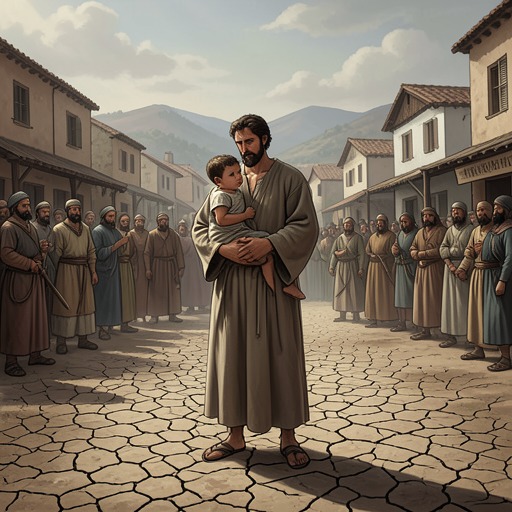
As the drought continues, the prescribed rites fail. Knecht leads processions and sacrifices, but the village’s despair grows; Maro incites the people against him, and the tribal mother is pressed to demand his death. With Ada gravely ill and the community facing hunger, Knecht chooses to act before he is seized as an unwanted failure. He dresses Turu in the ceremonial robes, presents him to the tribal mother as his successor, and offers himself for sacrifice. She accepts the proposal.
At the clearing Knecht has chosen, the village gathers in a silent procession. In the center of the circle, he states that he served as Rainmaker for many years, that the powers are now against him, and that his sacrifice should placate them. He directs the people to recognize Turu as the new Rainmaker and urges them to follow his son’s instructions after his death. The transition makes explicit what the moonlit teaching had foreshadowed: the office is not merely a store of techniques but an inheritance that must pass from one life to another. Knecht’s final act fulfills the community’s harsh custom while placing the next season, and the survival of the village’s seed, in his successor’s hands.
Meaning of the Art
Rainmaking is presented through a worldview in which nature is neither a passive object nor an adversary to be conquered without remainder. Knecht and Turu seek knowledge of natural laws, but they do so as participants within the world they observe. Their attention can guide action and deepen understanding; it cannot guarantee rain. The crisis therefore exposes the distinction between skill and sovereignty: the Rainmaker can judge, prepare, and perform the rites, yet remains answerable to forces that may defeat his best efforts.
The office also turns knowledge into a social obligation. The Rainmaker’s insight matters because planting, harvest, and communal survival depend on it, while the danger of the role becomes greatest precisely when his service appears to fail. Knecht’s willingness to offer himself is not an ornamental rite detached from practical consequences: he names a successor and directs the protection of seed grain, joining sacrificial tradition to the community’s immediate future. Through Rainmaking, the narrative sets embodied, inherited knowledge beside formal systems of learning and makes service, uncertainty, and succession inseparable from the pursuit of order.